Shutdown Day is a global experiment to find out how many people can go without a computer for one whole day, and what will happen if we all participate. This will happen on May 3, 2008.
If you check out the website you will see some interesting answers on what they'll do on Shutdown day.
As for me, I'd probably bike, or eat! How about you?
Sign up na!
Wednesday, April 23, 2008

Tuesday, April 1, 2008
ICT integration in Classroom teaching

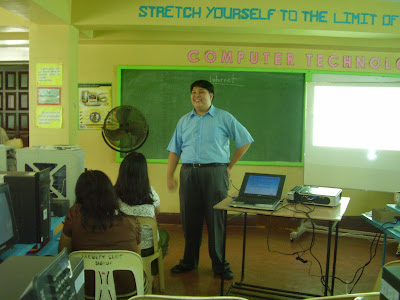
This photo is from a class in an ICT High School in the Philippines. This school is under the Department of Education, a public high school.
It prides to have a special ICT curriculum for teaching and learning, and has the necessary facilities for implementing its curriculum. In fact, in this particular class, they are using a laptop and an LCD projector to present lessons.
Wow! This school seems to be special.
I particularly enjoyed observing this class because the students are very active (I hope they are consistently active in their classes and not just because there are observers), and that the teacher is very skilled in facilitating classroom discussion. But I was sad because the projection of the lessons through an LCD projector seemed like a 'glorified blackboard.' Which means, the lessons can actually be written on the blackboard and would have the same impact on the students.
Through this incident I have become more curious on what ICT integration in teaching and learning in the classroom is all about. What are teachers' ideas on ICT integration? How can we say that a class that utilizes ICT is really able to integrate ICT in teaching and learning? Was this class that I have observed practiced ICT integration?

Friday, March 28, 2008
The eSkwela Project
I am now involved in a project that uses ICT in education in the alternative education setting. It is called eSkwela. It is a project of the Commission on Information and Communications Technology (CICT) and the Department of Education (DepEd).
eSkwela prides to have produced several digitized e-learning modules for the use of out-of-school youth and adults (OSYA) in the Alternative Learning Systems (ALS). I think ICT is a great way to bring education to the OSYAs because it allows for flexibility in studying and learning among OSYAs. The flexible entry and exit component in the ALS program is one of its unique features that differentiates the delivery of education in the formal setting.
What I also liked about this project is the advocacy on the use of open source software, such as Edubuntu. Edubuntu is an example of open source software that was made by educators and technologists to suit the need of schools. The software contains very nice educational applications that can be used to teach lessons in a more interesting and fun manner. Having the computers, Edubuntu software and digitized modules truly helps improve the learning of the OSYAs that are enrolled in the eSkwela program.
The eSkwela has been recognized by the UNESCO through its ICT in Education Innovation Awards. It has received a Certificate of Commendation for the Non-formal Education category.
It makes me proud to be part of this very noble endeavor. What I like most about this project is that it has given attention to the alternative education sector, which hardly receives much attention from local officials and the private sector. Even the DepEd provides a very minimal budget for ALS while it caters to about 20% of the population that are out-of-school. I hope that as we go along with the project we would be able to further enhance the delivery of education, especially to the OSYAs.
eSkwela prides to have produced several digitized e-learning modules for the use of out-of-school youth and adults (OSYA) in the Alternative Learning Systems (ALS). I think ICT is a great way to bring education to the OSYAs because it allows for flexibility in studying and learning among OSYAs. The flexible entry and exit component in the ALS program is one of its unique features that differentiates the delivery of education in the formal setting.
What I also liked about this project is the advocacy on the use of open source software, such as Edubuntu. Edubuntu is an example of open source software that was made by educators and technologists to suit the need of schools. The software contains very nice educational applications that can be used to teach lessons in a more interesting and fun manner. Having the computers, Edubuntu software and digitized modules truly helps improve the learning of the OSYAs that are enrolled in the eSkwela program.
The eSkwela has been recognized by the UNESCO through its ICT in Education Innovation Awards. It has received a Certificate of Commendation for the Non-formal Education category.
It makes me proud to be part of this very noble endeavor. What I like most about this project is that it has given attention to the alternative education sector, which hardly receives much attention from local officials and the private sector. Even the DepEd provides a very minimal budget for ALS while it caters to about 20% of the population that are out-of-school. I hope that as we go along with the project we would be able to further enhance the delivery of education, especially to the OSYAs.
Saturday, February 2, 2008
Blog changes
I may hardly be able to talk about GILAS anymore, as I am moving to another job. But the job will be similar, as I will still be able to continue my advocacy on ICT in Education.
'Til next blog entry!
'Til next blog entry!
GILAS in Pampanga

GILAS has arrived in Pampanga! Orientation among the principals of the public high schools transpired last September 2007, and 7 schools got connected last December 2007 - January 2008. GILAS training took place at San Roque Dau High School in Lubao last January 23, 24 and 25, 2008. 30 teachers attended the training.
Wednesday, October 24, 2007
GILAS in Lipa City

Today we conducted an Internet Literacy training for the teachers in Lipa City, Batangas. Lipa City is one of the cities in the Philippines where all its public high schools are fully connected. This is indeed a sign of progress, and we hope that the teachers who attended this training will be able to share what they learned to their fellow teachers, co-workers and students. :)
Monday, October 22, 2007
GILAS in Manila
GILAS has assisted more than 20 schools in the division of city schools (DCS) Manila. We recently finished the training for close to 40 teachers, mostly computer teachers of their respective schools.
The picture above was taken from the Internet Literacy training at Esteban Abada High School in Sampaloc, Manila. Leading the training is Mr. Doy Dulce, a college teacher, and a proud product of DCS Manila (graduated from Manila Science High School).
The picture above was taken from the Internet Literacy training at Esteban Abada High School in Sampaloc, Manila. Leading the training is Mr. Doy Dulce, a college teacher, and a proud product of DCS Manila (graduated from Manila Science High School).
Subscribe to:
Posts (Atom)